From farm to cup
The journey of our coffees at Goodlife
By Stephanie - 3 June, 2026
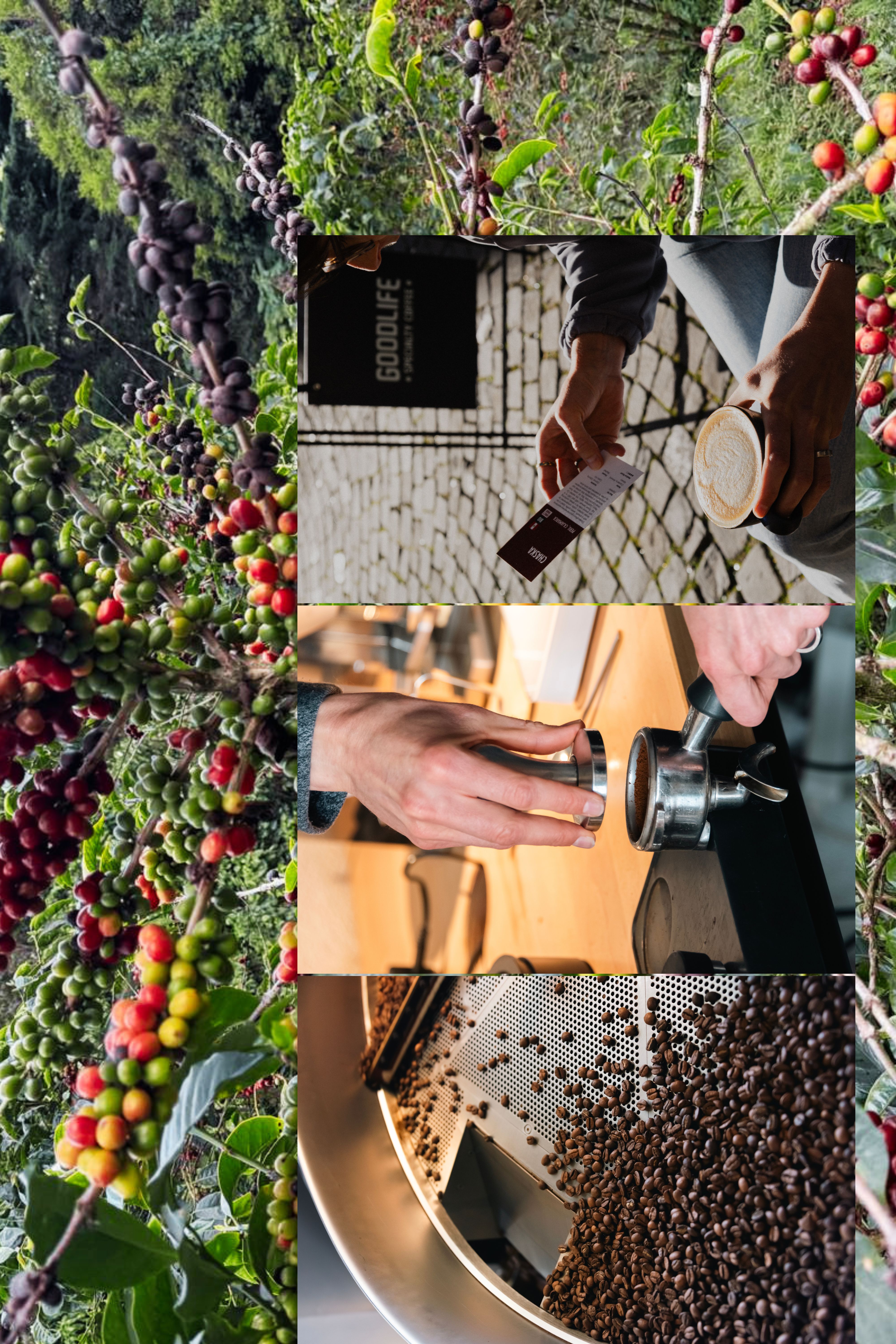
At Goodlife Coffee, we like to remind people that coffee does not start in a roasting workshop, but on a farm located in tropical regions. Between the flowering of the coffee tree and the final cup, there are often 6 to 12 months of work, decisions, tastings, and transportation. Every coffee we offer is the result of a long journey that we build step by step with our partners.
In this article, we follow the journey of three of our coffees: Chaska (Aprocassi, Peru), Chapina (Conebosque, Guatemala), and Urumuri (Gasharu, Rwanda).
Harvest: the starting point of the journey
Everything begins with the harvest, in high-altitude regions where coffee trees grow in tropical zones, on often steep and difficult-to-access slopes. This is a crucial stage, as it directly determines the final quality of the coffee.
In Peru, Chaska, produced by the Aprocassi cooperative, is grown between 1,400 and 1,850 meters above sea level. In Guatemala, Chapina, from the Conebosque cooperative, grows on mineral-rich volcanic soils. In Rwanda, Urumuri, cultivated by the Gasharu cooperative, comes from fertile hills near Lake Kivu, where altitude and climate support slow and even cherry maturation.
Coffee harvesting is entirely manual. Farmers go through the plots several times to pick only perfectly ripe cherries. Unlike mechanical harvesting, this work requires precision, patience, and experience: each cherry is hand-selected, ensuring greater uniformity and higher quality in the lot.
This harvest often takes place over several weeks or even several months, as all cherries do not ripen at the same time. Producer families therefore return regularly to the same trees for multiple picking rounds. This slow rhythm is an essential part of specialty coffee quality.
Once picked, the cherries are quickly transported to processing stations, often the same day or within 24 hours, in order to preserve freshness and avoid uncontrolled fermentation. This is the moment when the coffee journey continues to the processing stage.
Processing: turning the cherry into green coffee
After harvest, the cherries are processed quickly, usually within 24 to 48 hours. This is the stage where the fruit becomes green coffee.
It is important to note that Chaska and Chapina are washed coffees, while Urumuri is a natural coffee. Washed coffees are pulped, fermented, and then washed, before being slowly dried on African beds for around 10 to 20 days. For Urumuri, the cherries are dried whole, which creates a fruitier and sweeter profile. This work is carried out in the cooperatives’ stations: Aprocassi, Conebosque, and Gasharu.
Samples: our first contact with the coffee
Before the coffee even leaves its country of origin, we receive carefully prepared samples from the cooperatives. This is the first time we truly encounter the coffee in its future form, even before it physically arrives in Europe.
These samples are the result of harvesting, fermentation, and drying. They are sent in small quantities, but they already carry the full identity of the lot. We taste them through cupping, under standardized conditions, to objectively compare each coffee.
During these tastings, we aim to understand the coffee in its entirety: cleanliness, texture, balance, acidity, sweetness, and above all its potential. This is often the moment when a relationship with a lot begins to form: we already imagine how it could be roasted and how it will perform in espresso or filter.
Cupping is also a moment of projection. We are not only tasting what the coffee is, but what it can become after roasting. It is a moment of listening and interpreting the producers’ work, where each cup already tells part of its future journey.
The samples thus become a direct link between the farm and our roastery: a first silent conversation with the coffee that guides all our purchasing decisions.
Export: a 4 to 8 week journey
Once dried, the green coffee is sorted and packed in jute bags lined with GainPro to protect it during transport. It is then shipped by sea to Europe.
Chaska, Chapina, and Urumuri each follow their own route from Peru, Guatemala, and Rwanda. The transport takes on average 4 to 8 weeks, during which the coffee remains stable and protected.
Roasting at Goodlife Coffee: revealing the coffee
Upon arrival in Lausanne, each coffee is tested to define its roasting profile. We taste it as espresso and filter to choose the best roast level.
The roasting is then adjusted for each origin:
Chaska: medium espresso roast to balance acidity and bitterness
Chapina: light roast for espresso and filter
Urumuri: light roast for espresso and filter
The roasting itself only takes a few minutes, but it requires great precision to reveal the coffee’s full potential.
From cup to experience
Each coffee is then prepared as espresso, filter, or using gentle brewing methods, revealing different facets of its journey.
At Goodlife Coffee, every cup tells a complete story, from the tropical farm all the way to your cup.